AI Usage SIEM Streaming
Verdictan can stream bounded AI Usage Records to your SIEM or log-management platform.
The record contains the request, response, governance decisions, leakage findings, and financial metadata. Security and compliance teams can examine exposure, exfiltration, and policy violations.
Use request_id, record_id, and trail_event_id to correlate available
evidence. Capture limits, redaction, filters, and delivery state affect what a
destination receives.
Supported destinations
| Destination type | Target system | Auth method |
|---|---|---|
splunk | Splunk HTTP Event Collector (HEC) | HEC token (Authorization: Splunk) |
elastic | Elasticsearch bulk API | API key (Authorization: ApiKey) |
datadog | Datadog logs-intake endpoint | DD-API-KEY header |
generic_https_json | An HTTPS JSON collector | Bearer token (Authorization: Bearer) |
All destinations must use HTTPS endpoints. Non-HTTPS transports are not in scope. Verdictan validates each destination endpoint against its SSRF policy. Verdictan does this validation during configuration and each delivery attempt.
Configure a destination
Prerequisites
- You must have the AI Usage Stream Write permission
(
AI_USAGE_STREAM_WRITE) on the organization. - Your destination must accept HTTPS ingestion.
Console setup
- Go to Settings → AI Usage SIEM Streaming.
- Select Add Destination.
- Select the destination type (
splunk,elastic,datadog, orgeneric_https_json). - Type the endpoint URL.
- Wait for Verdictan to validate the URL against the SSRF policy. The policy rejects private, loopback, and link-local addresses.
- Type the destination credential. Verdictan encrypts the credential before storage.
- Select the redaction mode. Read Redaction modes.
- If you must stream a subset of records, configure event filters.
- Save the destination.
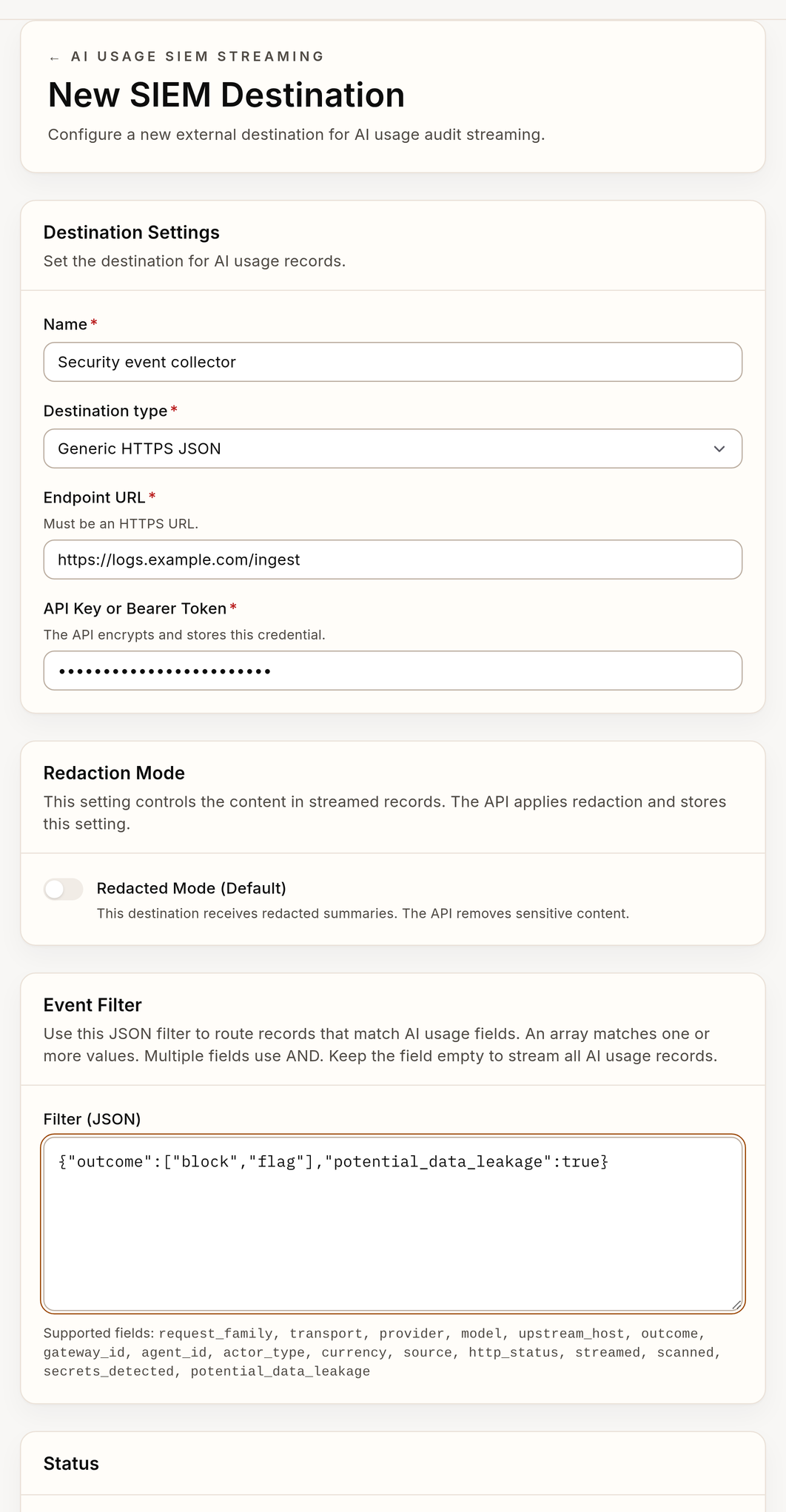
Example SIEM destination form with synthetic data. The form uses redacted mode.
Per-destination setup
Splunk HEC
- In Splunk, create an HTTP Event Collector token or use an available token.
- Get the HEC endpoint URL. A usual URL is
https://your-splunk:8088/services/collector/event. - In Verdictan, create a destination with type
splunk, the HEC endpoint URL, and the HEC token as the credential. - Verify that Verdictan sends each record as an NDJSON event envelope
(
{"event": <record>, "sourcetype": "verdictan:ai_usage", "source": "verdictan-api"}) using theAuthorization: Splunk <token>header.
Elasticsearch
- In Elasticsearch, create an API key with write access to the target index.
- Get the bulk API endpoint. A usual endpoint is
https://your-elastic:9200/_bulk. - In Verdictan, create a destination with type
elastic, the bulk endpoint URL, and the API key as the credential. - Verify that Verdictan writes each record to the
verdictan-ai-usageindex. The request must use the Elasticsearch bulk NDJSON format. The format has anindexaction line and then the record. The request uses theAuthorization: ApiKey <key>header.
Datadog
- In Datadog, create an API key or use an available API key.
- Get the logs-intake endpoint for your Datadog site. Use this usual US endpoint:
https://http-intake.logs.datadoghq.com/api/v2/logs - In Verdictan, create a destination with type
datadog, the logs-intake URL, and the API key as the credential. - Verify that Verdictan sends each record to the logs-intake endpoint as a JSON log
object (
ddsource: verdictan,service: verdictan-ai-usage, with the record inmessage) using theDD-API-KEYheader.
Generic HTTPS JSON collector
- Get your collector's HTTPS ingestion endpoint.
- Provision a bearer token that your collector accepts.
- In Verdictan, create a destination with type
generic_https_json, the endpoint URL, and the bearer token as the credential. - Verify that Verdictan sends a POST request with a JSON object (
{"source": "verdictan", "schema_version": "1", "records": [<record>]}). The request uses theAuthorization: Bearer <token>andIdempotency-Keyheaders.
Redaction modes
Each destination has its own redaction mode. The mode controls how Verdictan delivers request and response content.
| Mode | Behavior | Default |
|---|---|---|
| Redacted | Verdictan replaces request_body and response_body with [REDACTED] before delivery. The record keeps detector findings and SHA-256 hashes. | ✅ Yes |
| Raw | Verdictan transmits captured request and response content without destination redaction. Capture limits continue to apply. | No |
Select a redaction mode
-
Use Redacted mode for most deployments. It sends available detector findings without captured request or response content.
The record contains each detector finding, category, entity type, confidence, and masked location. Investigators can see the detected data and matched policies.
They can also see the actions that Verdictan took.
-
Organizations can use Raw mode for captured forensic content in their SIEM. Before you enable raw mode, acknowledge the specified data-handling rules.
The
raw_data_handling_acknowledgedfield records this acknowledgement. Verdictan records the user and timestamp with the acknowledgement.
Make sure that your SIEM controls are correct for unredacted content. Raw mode sends unredacted request and response bodies to the external destination.
The gateway can truncate the request body or response body at the configured
capture limit. Examine request_truncated and response_truncated first.
These controls include access, retention, and data-handling agreements.
Event filters
Each destination can define an optional event_filter. The API evaluates the
filter when it captures an AI Usage Record.
The result specifies which active destinations receive outbox rows.
- Evaluation point: The API evaluates the filter when it enqueues the record. The same transaction stores the record and writes matching delivery rows.
- No data loss on mismatch: The API always stores the AI Usage Record. The API does not create a delivery row for a destination that does not match.
- Empty filter = match all: Do not include
event_filterto stream each record to the destination. You can also set it tonullor{}. - AND across fields: When the filter contains multiple fields, all fields must match.
- One value in arrays: String and
http_statusfields use exact-match arrays. A record matches when its stored value equals one value in the array.
The API validates the structure during create and update operations. The API rejects unknown fields, empty arrays, empty strings, and out-of-range HTTP status values.
Supported filter fields
These fields map directly to ai_usage_records columns:
| Filter field | Record column | Match type |
|---|---|---|
request_family | request_family | exact-match string array |
transport | transport | exact-match string array |
provider | provider | exact-match string array |
model | model | exact-match string array |
upstream_host | upstream_host | exact-match string array |
outcome | outcome | exact-match string array |
gateway_id | gateway_id | exact-match string array |
agent_id | agent_id | exact-match string array |
actor_type | actor_type | exact-match string array |
currency | currency | exact-match string array |
source | source | exact-match string array (gateway today) |
http_status | http_status | exact-match integer array |
streamed | streamed | specified boolean match |
scanned | scanned | specified boolean match |
secrets_detected | secrets_detected | specified boolean match |
potential_data_leakage | potential_data_leakage | specified boolean match |
Examples
Route only blocked or flagged OpenAI records that detected possible leakage:
{
  "provider": ["openai"],
  "outcome": ["block", "flag"],
  "potential_data_leakage": true
}
Route only streamed MCP traffic:
{
  "request_family": ["mcp"],
  "streamed": true
}
Route only upstream throttling or server errors:
{
  "http_status": [429, 500, 502, 503, 504]
}
AI Usage Record schema
When capture succeeds, a governed AI interaction creates one AI Usage Record. The record contains these groups:
Envelope
| Field | Description |
|---|---|
schema_version | This field contains the record schema version. |
record_id | This field contains the unique record identifier (UUID). |
org_id | This field contains the organization identifier. |
sequence | This field contains the monotonic sequence number for the organization. |
captured_at | This field contains the server-owned capture timestamp. |
source | This field identifies the capture source. The source is gateway. |
Identity and tenancy
| Field | Description |
|---|---|
gateway_id | This field identifies the gateway that processed the interaction. |
agent_id | This field contains the agent identifier. |
subject_token_id | This field identifies the token that the client used for the request. |
actor_id / actor_type | These fields contain the actor identity and type. |
session_id | This field contains the session identifier. |
correlation_id | This field contains the cross-system correlation ID. |
request_id | This field contains the unique request identifier. |
Interaction
| Field | Description |
|---|---|
request_family | This field identifies the request family (Chat, Responses, Messages, WebSocket, MCP). |
transport | This field identifies the transport type (buffered, sse, websocket, mcp). |
provider / model | These fields identify the AI provider and model. |
upstream_host | This field contains only the upstream host. It does not contain credentials. |
streamed | This field reports if Verdictan streamed the response. |
started_at / completed_at | These fields contain the start and completion timestamps. |
latency_ms | This field contains the total latency in milliseconds. |
outcome | This field contains the governance outcome (allow, block, flag, error). |
http_status | This field contains the upstream HTTP status code. |
Content
| Field | Description |
|---|---|
request_body / response_body | These fields contain captured request and response content. The gateway can truncate one or the two values. |
request_bytes / response_bytes | These fields contain the content byte counts. |
request_sha256_raw / response_sha256_raw | These fields contain the SHA-256 hashes of raw content. |
request_sha256_redacted / response_sha256_redacted | These fields contain the SHA-256 hashes of redacted content. |
request_truncated / response_truncated | These fields report if Verdictan truncated the content. |
Governance
| Field | Description |
|---|---|
matched_policies | This field contains the policies that matched the interaction. |
decisions | This field contains the applied governance decisions. |
applied_mutations | This field contains mutations that Verdictan applied to the request or response. |
applied_redactions | This field contains the applied redactions. |
output_stage_evaluations | This field contains output-stage evaluation results. |
human_oversight / escalation / flagged_review | These fields contain oversight references. |
Data leakage
| Field | Description |
|---|---|
detectors[] | This array contains detector findings. Read the subsequent table. |
redaction_mode_applied | Verdictan adds this field to redacted deliveries. The value is redacted when Verdictan removes the request and response bodies. |
secrets_detected | This field reports if Verdictan detected credential or secret patterns. |
attachments[] | This field contains file metadata (type, size, sha256, scanned). |
potential_data_leakage | This Boolean reports if Verdictan detected data leakage. |
Each entry in detectors[] includes:
| Field | Description |
|---|---|
detector | This field contains the detector name. |
category | This field contains the detection category. |
entity_type | This field identifies the detected entity type. |
match_count | This field contains the number of matches. |
confidence | This field contains the detection confidence. |
matched_policy_ids | This field identifies the policies that triggered. |
action | This field contains the action (redacted, blocked, allowed). |
evidence_locations | This field contains masked location evidence. It contains only offsets and hashes. |
sample_hash | This field contains a non-reversible hash of the matched content. |
Detector families include PII, HIPAA, PHI, DLP custom rules, and student privacy. They also include three platform scanners. These scanners find credential patterns, secret patterns, and high-entropy content.
An empty detectors[] with scanned: true means that the completed scan found
no reportable matches within its configured limits.
Financial
| Field | Description |
|---|---|
prompt_tokens / completion_tokens / cached_input_tokens / total_tokens | These fields contain token counts. |
cost / currency | These fields contain the interaction cost and currency. |
wallet_transaction_id / budget_id / reservation_request_id / spend_log_id | These fields contain financial references. |
Integrity
| Field | Description |
|---|---|
canonical_sha256 | This field contains the RFC-8785 canonical hash of the record. |
trail_event_id | This field correlates the record to the governance trail. |
Delivery guarantees
-
Delivery guarantee: Verdictan delivers each matching record one or more times. It retries a failed delivery until delivery succeeds or Verdictan quarantines the record.
Each delivery has a deterministic idempotency key (
<record_id>:<destination_id>). The generic HTTPS adapter sends the key in theIdempotency-Keyheader.Each record has a stable
record_idandcanonical_sha256. Your SIEM can use these values to remove duplicates. -
Durable scheduling: Verdictan stores an accepted record and its matching destination state together. It does not schedule a filtered destination.
-
Sequenced attempts: Verdictan sends records in sequence for each destination. It applies exponential backoff after failed attempts.
A retried record can be delivered after subsequent records.
-
Poison-record isolation: Verdictan retries a failed record a maximum of five times. Then, Verdictan quarantines it.
The failed record does not block subsequent records.
Monitoring delivery health
The delivery health view shows per-destination status:
- Pending / sent counts show records that wait for delivery and records that Verdictan delivered.
- Retryable / quarantined counts show records that await a different attempt. These counts also show records that Verdictan parked after all retries failed.
- Last delivered / last error shows the most recent delivery that succeeded. It also shows the most recent error from delivery.
- Attempt history shows recent outcomes for each destination attempt. These outcomes include the HTTP status, error code, and duration.
Gateway policy configuration
The gateway ai_usage_streaming policy stanza controls capture behavior on the
data plane. It does not control redaction or destination routing. You manage
redaction and destination routing in the console.
ai_usage_streaming:
  enabled: true
  body_capture_max_bytes: 65536   # 64 KiB per request/response (default)
  mandatory: false                # true = fail-closed if capture enqueue fails
| Field | Description | Default |
|---|---|---|
enabled | This field enables capture of AI Usage Records. | false |
body_capture_max_bytes | This field sets the maximum captured bytes for each request or response body. Verdictan limits the value to 1 MiB. | 65536 (64 KiB) |
mandatory | This field enables fail-closed behavior. Verdictan denies the AI request if durable capture enqueue fails. | false |
If the durable enqueue fails, mandatory: true makes the gateway return a 503
error. The gateway does not continue the AI request.
Use this setting when the request must stop after a capture enqueue failure.
Next steps
- Read Trail and audit evidence. Correlate streamed AI Usage Records with the governance trail through the shared
trail_event_id. - Read Reviewing alerts and evidence. Investigate the flagged and blocked interactions that your SIEM shows.
- Read Human oversight. Route high-risk interactions to human review before they complete.